LunchLink workplace catering guide
Boxed lunches vs. buffet catering for the office
Compare boxed lunches, platters, family-style meals, buffets, and hybrid catering using agenda, room, dietary, cost, waste, and delivery criteria.
LunchLink Editorial Team
Research and writing
LunchLink Catering Planning Team
Operational review

Direct answer
The short answer
Choose boxed lunches when people need a defined meal, fast distribution, named selections, staggered eating, or limited setup space. Choose platters or a buffet when the group can eat together, the room supports a service line, variety and interaction matter, and someone owns setup, replenishment, food holding, and cleanup. A hybrid can protect dietary or grab-and-go meals while the larger group uses shared service.
At a glance
Key takeaways
- Start with the agenda and room rather than appearance
- Separate boxed meals, platters, family-style service, and buffets—they are not the same workflow
- Compare total scope, not food subtotal alone
- Protect dietary meals through labels, placement, and distribution
- Plan queues, serviceware, holding, cleanup, and packaging before ordering
- Use a hybrid only when the two formats have a clear audience and owner
Use the quick comparison before choosing a format
The useful question is not whether boxes or buffets are generally better. It is which format removes the most friction from this agenda, room, headcount, dietary workflow, and delivery route.
Treat shared platters and a true buffet as separate options. Platters may be dropped on a boardroom table with minimal setup; a buffet can require dedicated tables, traffic flow, serving equipment, holding equipment, replenishment, and cleanup.
| Decision factor | Boxed or individual | Platters or family-style | Buffet | Hybrid |
|---|---|---|---|---|
| Agenda | Strong for fixed seats, short breaks, staggered schedules, and working sessions | Works when the table can support passing or self-service | Best when the agenda includes a real meal break | Useful when some people need grab-and-go while others eat together |
| Room | Needs sorting and pickup space but no service line | Needs table space near the group | Needs service tables, circulation, and often a separate eating area | Needs clearly separated zones so formats do not interfere |
| Choice | Choice is collected before ordering | Guests choose from a shared assortment | Guests can compose a plate from available components | Preselected meals can coexist with shared choice |
| Dietary handoff | Can support named or category labels when confirmed | Requires protected serving utensils and placement | Requires signage, line design, and cross-contact questions | Can isolate confirmed dietary meals from the general line |
| Portion control | One defined meal per person | Depends on provider yields and self-service | Depends on yields, utensils, line order, and replenishment | Requires a written split to prevent double-counting |
| Setup and cleanup | Lower setup; more package sorting and disposal | Moderate setup and shared cleanup | Highest room, equipment, service, and cleanup coordination | Two workflows must be managed deliberately |
Choose boxed lunches for speed and defined distribution
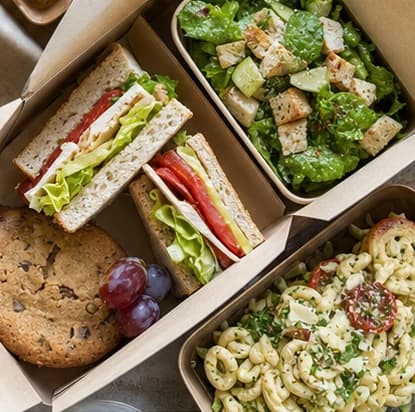
Individually packed meals work well when attendees remain at their seats, leave at different times, move between rooms, or submit named selections. The format makes the unit count clear and can protect separately confirmed dietary meals when labels and distribution are accurate.
The tradeoff is administrative and physical packaging. Someone must collect selections, resolve non-responses, reconcile dietary categories, count the delivered boxes, sort them without exposing private information, and manage the waste stream. A box is not automatically a complete meal; confirm the main item, sides, condiments, beverage, dessert, cutlery, and label content.
- Fixed-seat board meeting or working session
- Short or staggered meal break
- Named employee selections
- Multiple rooms, floors, or pickup waves
- Limited space for tables and queues
- Confirmed separately packed dietary meals
Choose platters or family-style service for a smaller shared table
Platters and family-style meals create a shared experience without necessarily building a full buffet. They can suit a team table, informal lunch, or meeting room where people can reach the food without creating a long queue.
Ask how each item is portioned as part of the complete menu, which serving utensils are supplied, where dietary items will be placed, and who will open, arrange, and clear the containers. Shared service can become awkward when the room has fixed seating, narrow tables, or no surface outside the meeting materials.
- Small or medium group eating at roughly the same time
- Room with a usable side table or central dining table
- Menu designed to share without complicated assembly
- Organizer available to set out and clear the meal
- Provider-confirmed yields and serving utensils
- Protected placement for separately confirmed dietary items
Choose a buffet only when the room and run-of-show support it
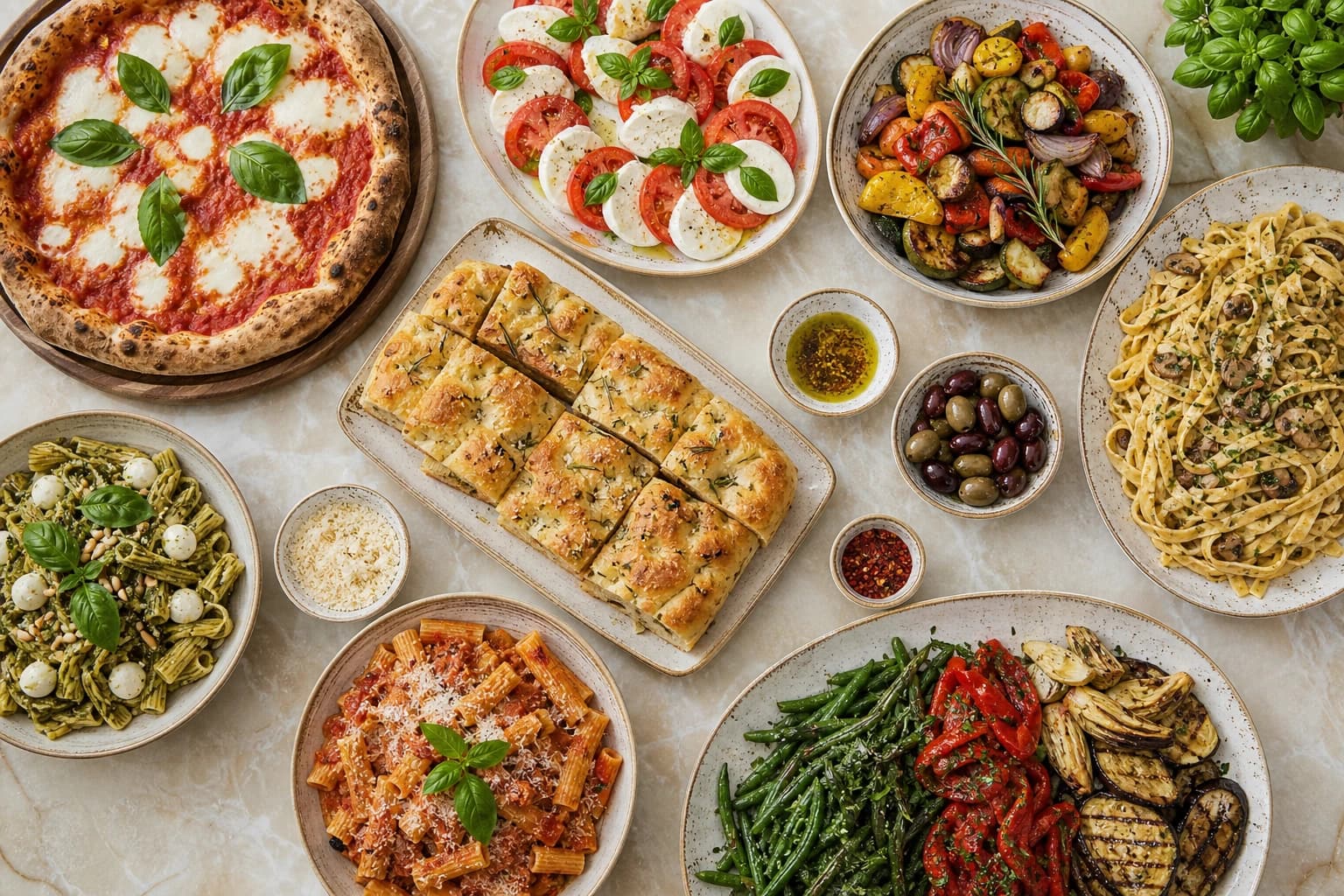
A buffet offers visible choice and can support a social meal, but the service line becomes part of the event. Determine how many people can leave their seats, how the line will flow, when food arrives, who sets it out, who replenishes it, and where used plates and waste go.
Hot or cold service may require equipment and time controls confirmed with the provider. Clarify whether setup, staff, chafing equipment, fuel, serving utensils, linens, pickup, and cleanup are included. A drop-off of large containers is not automatically a staffed buffet.
- Dedicated meal break rather than food during a presentation
- Adequate service tables and accessible circulation
- Clear line entrance and exit
- Provider-confirmed holding and service equipment
- Named setup, replenishment, and cleanup owners
- Dietary signage and protected utensils
Match the format to common office scenarios
The event purpose often resolves the decision faster than the menu. The table below shows a starting format to assess, not a guarantee that every provider or room can support it.
If the recommended format conflicts with building access, dietary handling, budget, or the selected menu, change the format. The operational fit matters more than following a generic event label.
| Scenario | Format to assess first | Why | Question that can change the answer |
|---|---|---|---|
| Board meeting | Individual meals or compact platters | Keeps the table and agenda controlled | Will participants pause together, or continue working while eating? |
| Lunch and learn | Labelled individual meals | Reduces queue time and lets attendees settle before the session | Is there a separate pre-session pickup area? |
| Team social | Platters, family-style, or buffet | Supports choice and interaction | Does the room actually allow a service line and cleanup? |
| All-hands | Buffet, multiple stations, or pre-sorted individual meals | Large groups need planned circulation or controlled release | How many service points and how much break time are available? |
| Hybrid anchor day | Individual pickup or a deliberately sized shared service | Attendance and schedules may fluctuate | Are employees selecting meals before the cutoff? |
| Multi-floor meeting | Individual meals grouped by floor or team | Simplifies movement after delivery | Who receives, counts, and releases each group? |
Compare the dietary workflow, not just the menu labels
Individual packaging can make a confirmed dietary meal easier to identify, but only when the provider has verified the option and the label is accurate. A generic sticker such as 'special' is not enough if the receiver cannot match it to the agreed requirement.
A buffet or platter setup needs more than menu cards. Ask about ingredients, preparation, shared utensils, placement, and cross-contact limitations. The Canadian Food Inspection Agency identifies eggs, milk, mustard, peanuts, crustaceans and molluscs, fish, sesame, soy, sulphites, tree nuts, and wheat and triticale among Canada's priority allergens; a dish name alone does not resolve those questions.
| Control | Individual meals | Shared service |
|---|---|---|
| Provider confirmation | Confirm each selected meal and its label | Confirm each dish, ingredient information, and handling limitation |
| Receiving | Count and separate dietary packages before general pickup | Identify protected dishes and dedicated utensils before opening service |
| Attendee identification | Use the agreed name, code, or category without displaying unnecessary personal details | Use accurate dish signage and a named person for questions |
| Cross-contact | Packaging can reduce onsite mix-ups but does not prove kitchen controls | Shared utensils and guest movement add onsite risks that require planning |
| Late substitution | Stop and verify a replacement before distributing it | Update signage and tell the dietary attendee rather than assuming equivalence |
Compare the complete quote scope
Boxes can carry more packaging and assembly, while buffets can require staff, serviceware, equipment, linens, setup, pickup, or cleaning. Neither format is automatically cheaper. Compare proposals against the same headcount, menu role, delivery conditions, service window, dietary requirements, and tax treatment.
Ask what is excluded as carefully as what is included. An attractive buffet food subtotal can become the more complex option after holding equipment and staffing are added; a boxed meal price can omit beverages, dessert, delivery, labels, or cutlery.
- Food and beverage inclusions
- Packaging and individual labels
- Delivery, parking, and building access
- Setup, staff, equipment, linens, and rentals
- Plates, cutlery, napkins, and serving utensils
- Pickup, cleanup, waste removal, fees, and tax
Plan food holding, service time, and leftovers
Ask the selected provider how the food should be held and how long the planned service can remain suitable. The answer may affect whether a long open buffet, staggered box pickup, or several smaller releases are practical.
Health Canada advises keeping food outside the 4°C to 60°C danger zone and discarding cooked food left at room temperature for more than two hours. A package or covered tray does not remove that requirement. Confirm refrigeration, hot holding, timing, and leftover instructions rather than extending service by guesswork.
- Planned arrival and eating time
- Maximum service window confirmed with the provider
- Cold storage or hot-holding responsibility
- Time each format is opened or released
- Process for unopened and served leftovers
- Cleanup and disposal owner
Use a hybrid format only for a clear reason
A hybrid can combine a shared meal with separately packed dietary meals, executive meals, offsite meals, or grab-and-go portions. It is useful when one format genuinely cannot serve the whole audience safely or practically.
Write down exactly who belongs to each format. Reconcile both subtotals to the total headcount, use separate staging zones, and brief the receiver so individual meals are not taken by buffet guests. Without that discipline, a hybrid creates duplicate cost and makes shortages harder to diagnose.
| Decision | What to document |
|---|---|
| Audience split | Which attendees receive individual meals and which use shared service |
| Quantity split | The two subtotals and proof that they reconcile to the guarantee |
| Staging | Separate pickup and buffet areas with clear signs |
| Timing | Whether both formats arrive and open at the same time |
| Dietary protection | Who receives and distributes protected meals |
| Quote scope | Which delivery, equipment, serviceware, and cleanup costs apply to each format |
Make the final choice with a room-and-agenda walkthrough
Before confirming, walk the path from building entrance to the eating area. Identify where the order is counted, where labels are checked, where guests queue, how they leave the service area, where they sit, and where waste goes. A five-minute walkthrough often reveals that the preferred format does not fit the actual room.
Send the final format requirements to every provider being compared. The request should state the agenda, expected attendance, dietary split, address, access route, room layout, eating time, setup expectations, serviceware, cleanup, and budget range. Treat the selected format as confirmed only when the provider accepts the complete scope.
- Can the delivery reach the room with the proposed containers and equipment?
- Can attendees collect food without blocking doors or presentation space?
- Is there enough time for the longest expected queue?
- Can dietary meals remain protected and identifiable?
- Who opens, replenishes, clears, and stores the food?
- Does the final quote include every responsibility?
Frequently asked
Questions workplace planners ask.
They are usually easier for fixed seats, short breaks, named selections, staggered schedules, or limited setup space. A buffet can be better when the group has a real meal break, the room supports a service line, and the event benefits from shared choice and interaction.
Neither is automatically safer. Individually packed meals can simplify identification and distribution when the option and label are confirmed. Shared service requires accurate dish information, protected placement, dedicated utensils, and explicit cross-contact questions. Provider verification remains essential for either format.
Not necessarily. Boxes may add packaging, assembly, and labels; buffets may add equipment, serviceware, staff, setup, pickup, or cleanup. Compare the complete quote for the same headcount, menu, delivery conditions, dietary requirements, and service responsibilities.
Platters or family-style containers can be placed on a shared table with relatively light setup. A buffet normally involves a designed service line, more table space, serving equipment, traffic flow, possible holding equipment, replenishment, and a larger cleanup plan.
Yes, when there is a clear operational reason—for example, separately packed dietary meals or grab-and-go attendees alongside a shared meal. Document the audience and quantity split, stage the formats separately, and assign a receiver so meals are not double-counted or misdistributed.
There is no universal buffer. Work backward from the eating time and include unloading, security, elevators, counting, setup, labels, and guest pickup. The selected provider should agree to a feasible delivery window that protects food quality and the agenda.