LunchLink workplace catering guide
Diwali catering checklist for Toronto offices
Use this Diwali catering checklist for Toronto offices to plan format, headcount, menu review, dietary requirements, sweets, delivery access, budget, and approval timing.
LunchLink Editorial Team
Research and writing
LunchLink Catering Planning Team
Operational review
Direct answer
The short answer
A Diwali catering checklist for Toronto offices should start with the celebration date, eating time, headcount, workplace format, budget range, dietary counts, delivery address, room access, and cultural-review owner. Then choose whether the event needs a buffet, individually boxed meals, a sweets-only spread, a chaat or live station, or thali-style service. Submit the complete brief at least 7 days before service, and begin 2-4 weeks ahead for 50 or more guests, live-station service, rentals, multiple drops, or detailed dietary and presentation review.
At a glance
Key takeaways
- Use one written Diwali catering checklist before comparing menus
- Match the format to the room: buffet, boxed meal, sweets-only, chaat station, or thali-style service
- Collect dietary counts before menu review and avoid blanket allergen or halal claims
- Confirm cultural terminology and presentation with the selected restaurant and client representative
- Send the complete request at least 7 days ahead; start 2-4 weeks early for larger or staffed events
- Treat the final quote as the source for menu, price, staffing, delivery, and service inclusions
Diwali catering checklist for Toronto offices: start here
Start the Diwali catering checklist with the fixed facts the caterer cannot guess: occasion, date, eating time, headcount, final-count deadline, full delivery address, building access, room, onsite receiver, budget range, dietary requirements, preferred format, and the internal person who can approve changes.
For 2026 planning, Diwali falls on Sunday, November 8 in Toronto, so many office celebrations may happen on a nearby weekday. Record the exact office event date rather than assuming the cultural date and workplace date are the same.
| Checklist item | What to write down | Why it matters |
|---|---|---|
| Occasion and date | Diwali lunch, afternoon sweets, client reception, staff event, or team celebration | The event type changes timing, menu depth, and setup needs |
| Headcount | Confirmed guests, possible additions, and final-count deadline | Menus, sweets, labels, and staffing depend on the actual count |
| Serving format | Buffet, boxed meals, sweets-only, chaat or live station, or thali-style service | Each format needs different room, labour, and handoff planning |
| Dietary requirements | Vegetarian, vegan, halal, gluten-aware, dairy-aware, allergy, and label counts | Suitability must be confirmed item by item with the selected restaurant |
| Delivery access | Address, entrance, loading, elevator, floor, room, setup table, and onsite receiver | Toronto office handoffs often fail because the room plan is incomplete |
| Budget and approvals | Budget range, billing contact, approver, and decision deadline | The quote can separate food, delivery, serviceware, staffing, rentals, and tax |
Choose the Diwali catering format before choosing dishes
A practical Diwali office catering plan begins with the room and agenda, not with a long menu list. A shared buffet can suit a lunchroom or larger gathering, while individually boxed meals are usually simpler for fixed seating, shorter breaks, split teams, and labelled dietary meals.
A sweets-only spread can support a brief celebration, recognition moment, or afternoon tea. A chaat or live station can make the event feel more interactive, but it needs enough floor space, a clear queue, service time, staffing, equipment, and cleanup. Thali-style service can keep several components organized for a structured meal when the selected restaurant can support it.
- Buffet: best when the room can handle shared service, labels, serving utensils, and replenishment
- Individually boxed meals: best when fast distribution, labels, or assigned seating matter
- Sweets-only spread: best for short celebrations, gifting moments, or an add-on to another meal
- Chaat or live station: best when the office has time, space, staffing, and setup permission
- Thali-style service: best when a complete meal needs to stay organized by portion and component
Build the menu around balance and confirmation
Use the menu as a planning vocabulary, not as a promise that every item is available. A balanced Diwali catering checklist can include starters, mains, rice, breads, sides, sweets, beverages, serviceware, labels, and the items that need dietary review.
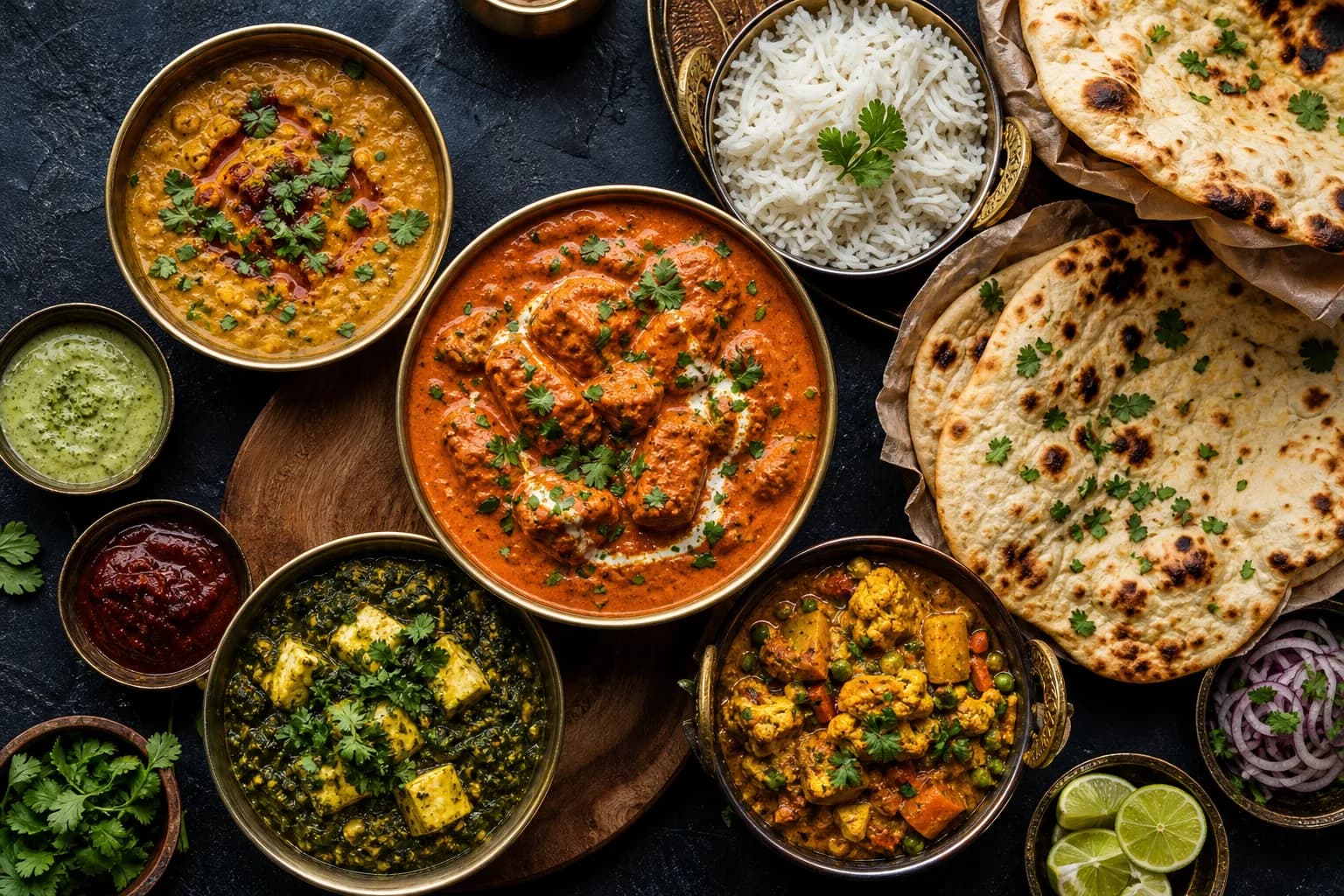
Approved Diwali planning vocabulary includes starters such as samosas, pani puri or chaat, paneer tikka, aloo or vegetable bonda, and dhokla; mains such as butter chicken, malai kofta, navratan korma, chicken or vegetable biryani, and dal makhani; rice, breads, raita, salads, and Indian sweets such as milk pedha, kalakand, barfi, halwa, and regional Gujarati or Bengali options where available.
| Menu group | Useful planning questions | Confirmation needed |
|---|---|---|
| Starters and chaat | Will guests eat standing, seated, or through a service line? | Current items, chutneys, spice level, labels, and service tools |
| Mains | Does the office need vegetarian-only, mixed vegetarian and non-vegetarian, or separate dietary meals? | Ingredients, substitutions, holding, serving portions, and dietary limits |
| Rice, breads, and sides | Will the sides complete the meal or only support mains? | Quantities, freshness window, serving utensils, and reheating or holding needs |
| Sweets | Is this a full dessert course, a sweets table, or takeaway-style treat? | Assortment, count, ingredients, allergens, presentation, and packaging |
Plan cultural review without making the office guess
Diwali menus can carry regional preferences, family traditions, religious expectations, and presentation details that a generic office-catering checklist may miss. Assign one client-side reviewer who can flag preferred terminology, regional style, presentation, and any items the team wants to avoid.
LunchLink's approved Diwali workflow requires menu terminology and presentation to be reviewed with the selected restaurant partner and a client representative before the event plan is finalized. That review should happen before the menu is circulated internally, especially for client-facing celebrations or diverse teams.
- Ask whether the celebration is lunch, sweets, reception, or cultural-program support
- Record regional preferences without treating one regional menu as universal
- Confirm dish names and descriptions before sharing the menu with employees
- Separate religious or cultural requirements from ordinary taste preferences
- Keep final wording tied to the selected restaurant's current menu
Collect dietary requirements early and protect the handoff
Dietary planning should happen before the menu is finalized. Count vegetarian, vegan, halal, gluten-aware, dairy-aware, allergy-related, and other requirements separately, and avoid asking employees for more personal or medical detail than the order needs.
Do not treat a dish name as proof of suitability. Ingredients, preparation, supplier changes, shared equipment, labels, substitutions, and cross-contact limitations must be confirmed for the selected restaurant and items. At delivery, labelled or protected meals should be placed where the onsite receiver can distribute them correctly.
| Requirement | Checklist action | Do not assume |
|---|---|---|
| Vegetarian or vegan | Count required meals and verify ingredients, dairy, ghee, eggs, and substitutions | That a vegetable dish is automatically vegan |
| Halal | Ask what standard or evidence the team requires and verify the selected items | That halal-friendly means halal-certified |
| Gluten-aware or dairy-aware | Confirm ingredients, preparation practices, labels, and cross-contact limitations | That a dish name or common recipe proves suitability |
| Allergy-related | Record the allergy and stated cross-contact concern, then request provider-specific confirmation | That any kitchen or item is allergen-free without current evidence |
Budget for food, delivery, setup, and service separately
For seasonal catering, LunchLink's approved planning range is CAD $15-$75 per person for food and menu planning, with a current minimum request of 10 people. Standard delivery is CAD $40, while setup, staffing, rentals, beverages, serviceware, cleanup, taxes, and complex logistics may change the final quote.
Use the budget section of the Diwali catering checklist to separate the per-person food target from the operational items around the meal. A chaat station, staffed buffet, extra setup time, multiple drops, or packaged sweets may be the right choice, but it should be quoted explicitly rather than hidden inside a rough per-person number.
- Food and sweets budget per person
- Delivery address and access constraints
- Disposable plates, cutlery, napkins, cups, labels, and serving utensils
- Setup, staffing, live-station labour, cleanup, and rentals
- Beverages, takeaway packaging, or gift-style presentation
- Tax, service charges, final-count deadline, and quote expiry
Use a Diwali office catering timeline
Send the complete request at least 7 days before the event so current menus, dietary handling, partner capacity, delivery timing, and presentation can be checked. Begin 2-4 weeks ahead for 50 or more guests, staffed chaat or live stations, rentals, multiple deliveries, client-facing events, or detailed cultural review.
The final confirmation should include the accepted menu, quantities, dietary labels, delivery window, setup responsibility, onsite receiver, staffing or equipment, final cost, payment or invoice process, and the person authorized to approve last-minute changes.
- 2-4 weeks ahead: set the event date, format, room, budget, and reviewer
- 7-14 days ahead: send the complete catering request and dietary counts
- 3-5 days ahead: finalize menu wording, quantities, labels, and service scope
- Event day: confirm receiver, room setup, delivery route, and protected meals
- After service: note attendance, leftovers, dietary issues, and improvements for next time
Copy this provider-ready Diwali catering checklist
Use this short version when requesting current options. Replace unknown values with clear ranges rather than guessing. A complete request helps the catering team respond with realistic formats, timing, and quote assumptions.
- We are planning Diwali catering for a Toronto office on [date] at [eating time].
- Expected headcount is [confirmed count], with a possible range of [range] and final count by [deadline].
- Preferred format is [buffet / boxed meals / sweets-only / chaat or live station / thali-style service], but we can consider alternatives if the room or timing works better.
- Dietary counts are [vegetarian], [vegan], [halal requirement], [gluten-aware], [dairy-aware], [allergy-related], and [other].
- Delivery is to [full address], with [entrance/loading/reception/elevator/floor/room] and onsite receiver [name or role].
- We need confirmation of menu terminology, presentation, ingredients, labels, serviceware, staffing, setup, delivery, tax, and final quote terms before approval.
Frequently asked
Questions workplace planners ask.
Include the event date, eating time, headcount, final-count deadline, full delivery address, room access, onsite receiver, budget range, preferred serving format, dietary counts, sweets or beverage needs, cultural-review owner, and approval deadline.
Submit the complete request at least 7 days before service. Start 2-4 weeks ahead for 50 or more guests, live chaat or station service, rentals, multiple drops, client-facing events, or detailed cultural and dietary review.
Buffets suit larger shared meals with enough room; boxed meals suit fixed seating and labelled distribution; sweets-only spreads suit shorter celebrations; chaat or live stations need space and staffing; thali-style service can organize a complete meal when the selected restaurant can support it.
Potential vegetarian, vegan, halal, and other dietary options can be reviewed, but suitability depends on the selected restaurant's current menu, ingredients, preparation practices, labels, substitutions, and cross-contact limitations.
No. The checklist is planning guidance. Exact items, terminology, prices, quantities, availability, dietary status, staffing, and delivery details must be confirmed in the current written quote for the selected restaurant and event.