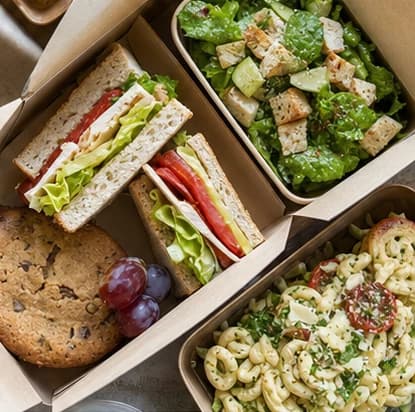
LunchLink office lunch ideas
18 Office Lunch Catering Ideas for Toronto Teams
Explore 18 office lunch catering ideas, sample menus for 20–100 people, Toronto budget examples, and a practical ordering checklist from LunchLink.
LunchLink
Catering ideas and planning

Direct answer
The short answer
Sandwich and wrap boxes, shawarma platters, taco bars, Indian lunches, pizza, and grain bowls are practical office lunch catering ideas. Choose individual meals for short breaks or staggered schedules, and shared platters or a buffet when everyone has time and space to eat together. Then narrow the menu using your team's preferences, confirmed dietary requirements, and total budget.
At a glance
Key takeaways
- Compare 18 menu ideas against the room and meeting schedule.
- Use complete meal selections and confirmed dietary requirements.
- Budget examples separate food, delivery, serviceware, and exclusions.
- Adapt the sample plans for 20, 50, or 100 people.
Find the right lunch for your team
That still leaves the question every office organiser faces: what should we actually order this time?
This guide compares 18 lunch ideas, explains what to include with each one, and gives you sample plans for 20, 50, and 100 people. You'll also find a four-week menu rotation and a brief you can copy into your next catering request.
The menu combinations below are suggestions to discuss with a caterer. They are not fixed LunchLink packages. LunchLink's cuisine menu guides describe planning categories; the restaurant, dishes, quantities, availability, and final price are confirmed for each order.
Choose an office lunch idea in one minute
Start with the constraint that is hardest to change. A short meeting break matters more than whether you prefer tacos or noodles.
| Your lunch situation | Start with these ideas | Detail to settle first |
|---|---|---|
| A working lunch at desks or in a boardroom | Sandwich boxes, burrito bowls, bento-style meals | Where meals will be distributed before the meeting |
| A relaxed team lunch in a common area | Shawarma platters, Indian buffet, taco bar | Table space and time for everyone to serve themselves |
| People eating in different rooms | Individually packed wraps, rice bowls, complete salad meals | Counts and labels for each room |
| A menu with substantial meat-free choices | Chickpea or tofu bowls, falafel plates, lentil and vegetable dishes | Exact recipes and individual requirements |
| A staff celebration | Caribbean lunch, BBQ plates, Greek platters | Whether a shared meal fits the event schedule |
| A tight budget | A short selection of wraps, pizza and salad, or rice-based meals | The complete quote, including fees and extras |
| A weekly lunch programme | Rotate cuisine while keeping the ordering process consistent | Attendance, selection deadline, and feedback |
These are planning recommendations, not a ranking of cuisines. The best menu is the one your team wants and your office can serve comfortably.
What should you budget for office lunch catering in Toronto?
LunchLink publishes a CAD $15–$75 per-person food and menu range, $40 standard delivery in approved service areas, and $0.50 per guest for a disposable plate, cutlery, and napkin set. Standard delivery includes floor delivery, parking, and basic setup. These are the site's published figures checked on September 15, 2026; the written quote confirms the final scope and total. Source: LunchLink's office catering cost guide.
For everyday lunch planning, begin with the food allowance your office can approve and ask which complete menus fit. Do not assume a specific cuisine is always the cheapest.
Worked planning examples for 20, 50, and 100 people
The table uses illustrative food allowances, not quoted menu packages. It assumes one standard delivery and one disposable set per person. Figures are in CAD and exclude tax, drinks or add-ons outside the food allowance, staffing, rentals, and any additional quoted charges.
| Team size | At $15 food per person | At $20 food per person | At $25 food per person |
|---|---|---|---|
| 20 people | $350 | $450 | $550 |
| 50 people | $815 | $1,065 | $1,315 |
| 100 people | $1,590 | $2,090 | $2,590 |
Calculation: headcount × food allowance + $40 delivery + headcount × $0.50 serviceware.
For example, 50 people at a $20 food allowance gives $1,000 for food, $40 for standard delivery, and $25 for disposable sets: $1,065 before tax and other additions.
The $20 allowance is a budget input. It does not mean every menu above is available at $20 per person. Larger orders, multiple delivery points, or expanded service may require a different logistics quote.
How to keep the order affordable
Compare two or three options against the same brief. Give each the same headcount, serving time, address, meal format, and inclusions.
Then make deliberate trade-offs:
- Keep the menu focused instead of adding several similar mains.
- Ask whether a side is already included before ordering it separately.
- Use confirmed attendance and an explicit allowance for possible additions.
- Decide whether drinks and dessert are part of this lunch's purpose.
- Check packaging, serving utensils, plates, setup, and cleanup in the quote.
- Compare the final amount the office will pay, including tax and any additional charges.
For a full estimate, use the calculator in the office catering cost guide.
Sample office lunch plans for different team sizes
These are illustrative briefs you can adapt. The meal counts are examples of confirmed selections, not recommended dietary percentages or restaurant package quantities.
A 20-person client workshop
Suggested approach: twenty individually packed lunches from a short menu, such as wraps or composed bowls.
An example selection list might be twelve chicken meals, five chickpea meals, and three vegetable meals. Each employee's full requirements still need to be matched to the exact dishes; the category names alone do not confirm suitability.
Why this plan fits: the organiser can count twenty complete meals, arrange them by selection, and distribute them before the next session.
Decision to confirm: who will receive the order and whether the meeting room has a separate pickup surface. If the only table is covered in laptops, choose another handoff spot.
A 50-person team lunch
Suggested approach: a shared shawarma, Greek, or Mexican menu if the group has a common lunch window and enough serving space.
Have the provider quote fifty complete lunches, with named quantities for each selected main. If twelve guests have chosen a particular alternative meal, record those twelve within the total of fifty.
Why this plan fits: a shared menu gives the group a common lunch occasion while leaving room for different selections.
Decision to confirm: whether the room supports the proposed service flow. A provider may suggest dividing the setup or prepacking some meals, but that needs to be part of the agreed order.
A 100-person training day across several rooms
Suggested approach: individually packed lunches grouped by room, with a separate list of selections for each room.
For four rooms of twenty-five people, request four labelled room groups totalling one hundred meals. The dietary and selection counts should reconcile within those room totals.
Why this plan fits: the receiver can send each group to its destination without sorting one hundred meals in a busy corridor.
Decision to confirm: the sequence of arrival, floor access, room handoff, and distribution. Use the provider's service recommendation for the actual menu and schedule; do not assume one delivery window suits every room.
For shared trays at any headcount, use the restaurant's confirmed serving yields. LunchLink's office catering quantity guide explains the inputs to provide before ordering.
Plan dietary requests before employees choose a meal
Build the selection process around complete meals. A guest requesting an alternative should be able to identify a main and its accompaniments, just as everyone else can.
Collect each person's stated requirements before approving the menu, including any questions they need the restaurant to answer. Send unresolved ingredient, preparation, substitution, or religious-requirement questions to the selected provider. Do not decide that a dish meets a person's needs solely from its cuisine, name, or photograph.
Use the same confirmed meal descriptions on the employee selection list, order summary, and agreed labels. If the menu changes, reconfirm affected selections before delivery.
LunchLink's dietary requirements checklist supports this handoff. This guide focuses on ordering and communication; the selected provider must address meal-specific preparation and suitability questions.
A four-week office lunch rotation you can reuse
Keep the administration familiar while changing what people eat. The following is a sample weekly rotation, subject to current menus and availability.
| Week | Menu direction | Suggested format | Feedback to collect |
|---|---|---|---|
| 1 | Sandwiches and wraps | Individually packed | Were the fillings clear and the meal complete? |
| 2 | Shawarma and falafel | Individual plates or a shared spread | Which mains and sides should return? |
| 3 | Indian rice-and-curry lunch | Individual selections or trays | Were the dish descriptions and heat levels clear? |
| 4 | Mexican bowls or a taco bar | Match the room and agenda | Did the format fit the available lunch time? |
For a small team, a simple choice between two complete meals may be enough. A larger team may need more options, but add them to meet actual requirements or preferences rather than to make the menu look extensive.
After each lunch, record attendance, meals ordered, selections taken, leftover portions, and brief feedback. Those observations are more useful for the next order than assuming last month's headcount still applies.
LunchLink offers recurring office meal programmes for teams that want an ongoing workflow. Confirm the schedule, current menus, ordering deadlines, and billing arrangements for your programme.
Toronto office delivery: details that belong in the lunch brief
A street address is only the start. The delivery plan should explain how the order reaches the place where people will eat.
Include the building entrance, reception or loading instructions, floor, room, elevator arrangements, and an onsite contact who can answer the phone. State the time food needs to be ready for distribution, as well as the agreed delivery window.
For a downtown office, establish whether the driver must check in, use a particular elevator, or hand the order to reception. For a business park or campus, identify the correct building and entrance. For several rooms or floors, agree who handles the final distribution.
Ask what basic setup includes for your order and which tasks remain with the office. Use LunchLink's downtown Toronto catering delivery checklist to prepare those details.
Copy this office lunch catering request
Subject: Office lunch request — [date], [headcount], [office location]
We are planning an office lunch and would like to compare suitable current menus.
- Date and occasion:
- Confirmed headcount and possible additions:
- Meal start time and any separate eating windows:
- Full delivery address, floor, and room:
- Preferred cuisines or two menu ideas:
- Preferred format: individual meals / platters / buffet / advice needed
- Total budget and whether it includes tax and fees:
- Meal selections and dietary counts:
- Questions the selected restaurant needs to resolve:
- Required drinks, sides, dessert, and serviceware:
- Building access and onsite contact:
- Setup, equipment, service, and cleanup requirements:
- Decision date, payment needs, and invoice details:
Please confirm the menu, portions, inclusions, delivery arrangements, final headcount deadline, change terms, and complete price before we approve the order.
Questions about choosing an office lunch
What can we order besides sandwiches and pizza?
Start with shawarma and falafel, Mexican bowls, an Indian rice-and-curry lunch, Persian plates, Thai dishes, Caribbean meals, or composed grain bowls. Choose two or three ideas the team likes, then ask which current menu fits the headcount and delivery plan.
Can one team lunch include more than one restaurant?
LunchLink says a multi-restaurant order depends on the occasion, order size, timing, and delivery coordination. Request it as part of the brief so the proposal can confirm whether it is practical. For regular lunches, rotating restaurants across separate dates is another way to provide variety. Source: LunchLink's service FAQs.
How far ahead should we request catering?
Send the brief once the date and likely headcount are known, then agree on the final selection deadline. LunchLink accepts urgent requests with at least four hours' notice, subject to confirmation of the partner, menu, route, capacity, and delivery time. That is a request window, not guaranteed availability. Source: LunchLink office lunch catering.
What if attendance changes after we choose the menu?
Ask for the final headcount deadline and change terms before approving the order. Keep confirmed guests separate from possible additions, and update both the meal total and the selection counts when someone joins or cancels. The provider must confirm whether a late change can be accommodated.
Turn your shortlist into a confirmed team lunch
Pick two menu ideas from this guide and send LunchLink your headcount, office address, date, meal time, dietary requirements, and budget. That gives the team enough context to compare suitable current options and confirm the details in writing.
Request an office lunch catering quote, or review LunchLink's office lunch catering service for the ordering process.